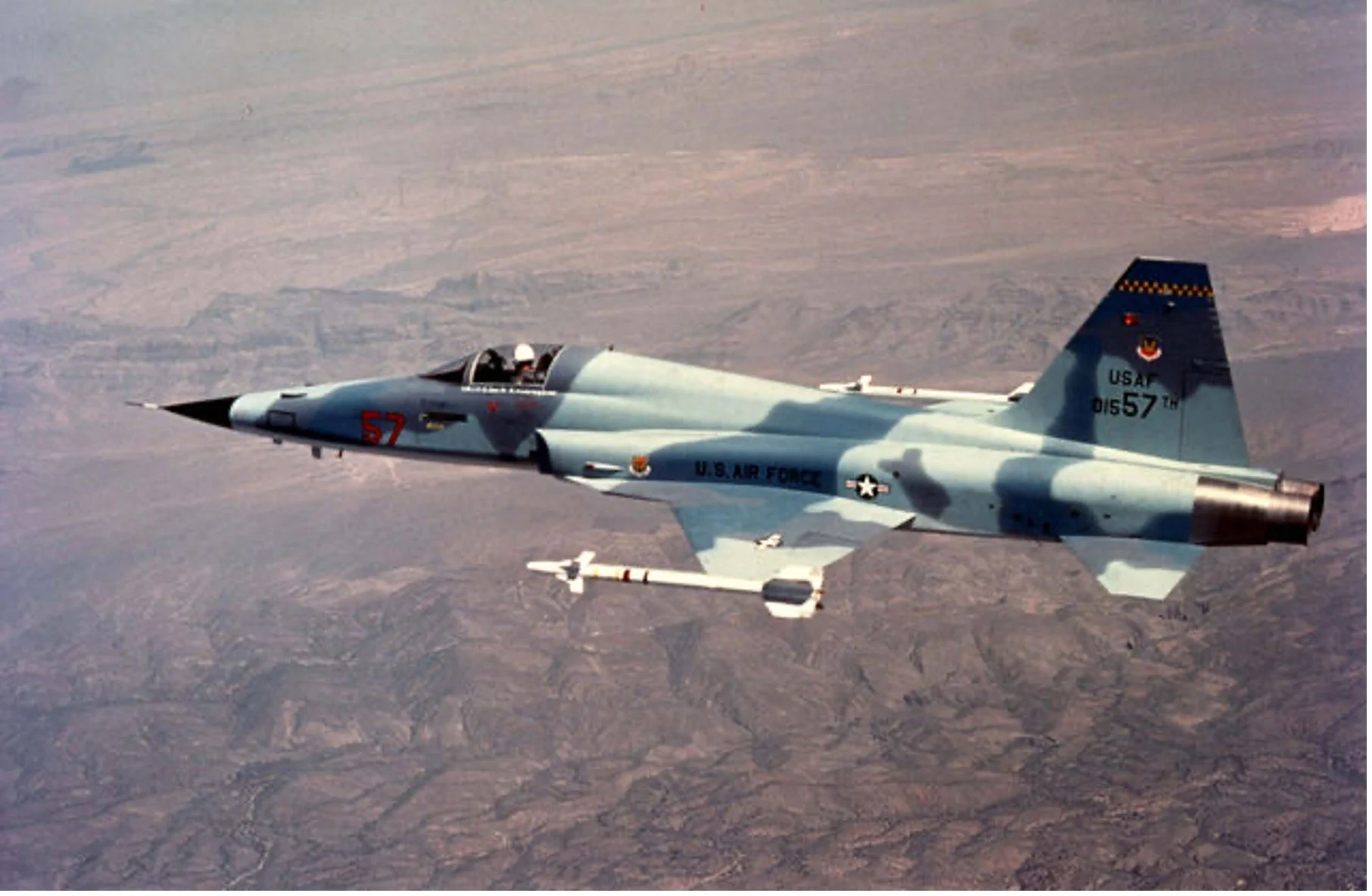
A legend in my own mind
In order to join the U.S. Air Force to fly fighter jets, most times, you had to have a four-year college degree. Dropping out of high school and having an arrest record after riding with an outlaw motorcycle club were rather frowned upon.
Back in the eighties, I had an idea. Maybe I could get around that. I read that the Soviet Union had a numerical advantage of tactical fighter jets of as much as sixty percent over the United States.
The Russkies were building cheaper fighters by the thousands.
We focused on more expensive airplanes like the F-16 and F-15, but fewer of them.
Historically, no matter how good you are in combat, if you get overwhelmed numerically, you’re going to lose.
My brilliant idea was for the United States to build smaller, cheaper fighters, and lots of them. Instead of the more expensive General Dynamics F-16, the smaller, cheaper twin-engine Northrup F-5E was the obvious choice, right?
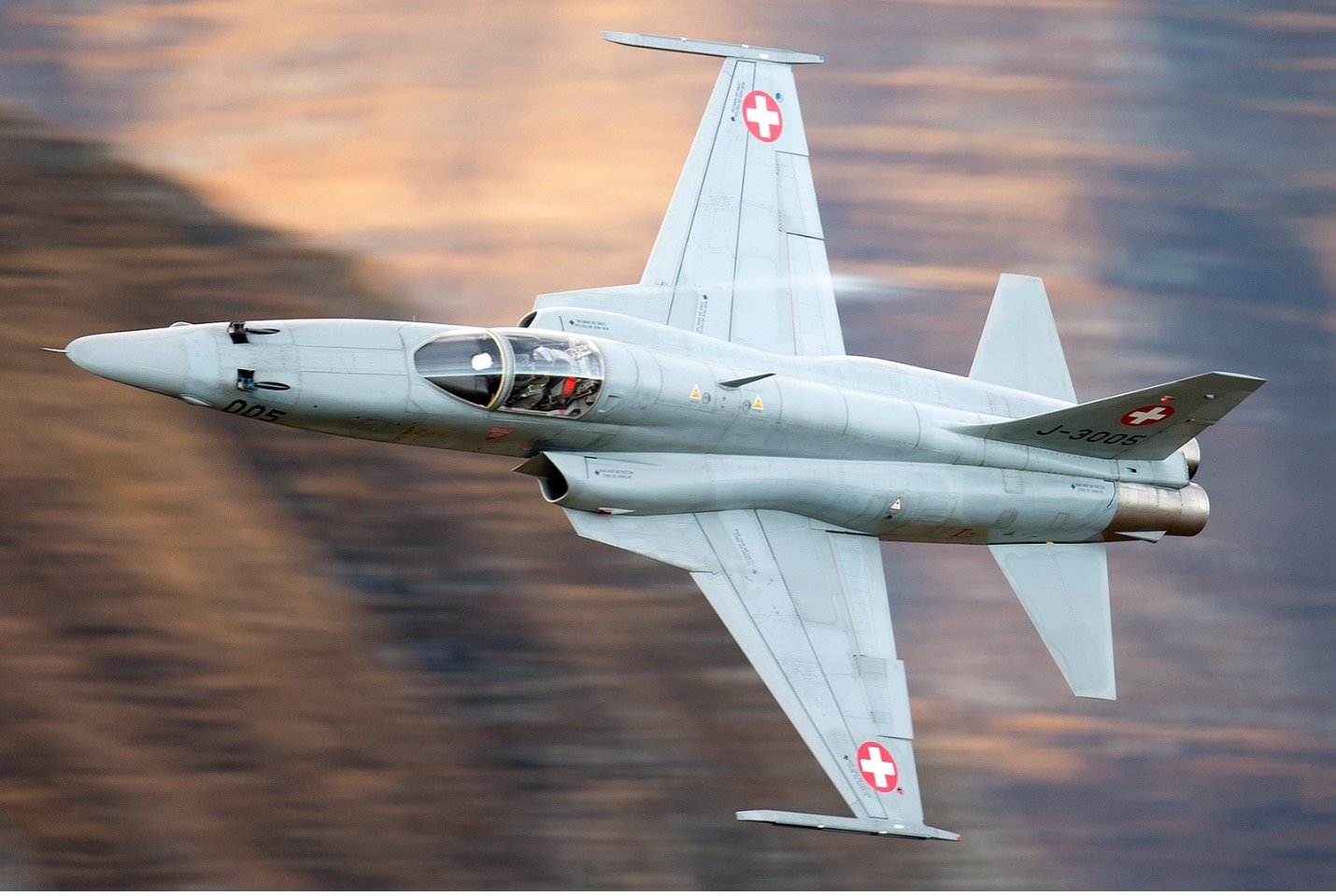
A Swiss F-5E
Designed in the late 50s, the F-5 was designed to reverse the trend of bigger, heavier, more complex and expensive fighters. They are known for their reliability and low maintenance.
The Kennedy Administration decided it would be the perfect airplane to sell to friendly or neutral countries. It was a hit and was exported to countries all over the world.
Even on the internet, it is difficult to find the cost of what the government paid for aircraft, especially in 1985. No doubt, that is on purpose. But some figures I could find were $14,000,000 for an F-16, while an F-5 costs just $2,100,000.
Compare that to the current cost of an F-35B at 121.4 million dollars. Never one to save the taxpayer money, the Air Force chose the F-16.
Using the figure of 14 million dollars apiece, the price for 4,604 of them would be 64.5 billion dollars. But that’s a lowball number with the increased cost over time.
General Dynamics F-16
Using that number, building 4,604 F-5Es would have cost 9.6 billion.
Or conversely, if we spent 64.5 billion dollars on F-5Es, we could have bought 30,714 of them.
But where would all the extra pilots come from? It takes years of training and millions of dollars to produce a fighter pilot. No problemo, I thought. We could use commercial pilots as volunteers to fly the cheaper, simpler F-5s.
People like… ME.
In 1985, I was flying Learjets. I’ve often said that flying Lears was the closest thing you could get to a fighter in civilian aviation. The engine in the older twenty-series Learjets was the same as the General Electric J85 in the F-5, only without an afterburner.
I was sure there were thousands of pilots like me who would volunteer to fly fighters on the weekends and help to defend our country. We could easily overwhelm the Soviet Union with massive numbers of F5s.
You’ve seen them before: in the movie Top Gun, F-5s played the enemy MiG-28s. (There is no such thing).
Top Gun, the Navy’s Fighter Weapons School, uses them as aggressors, complete with Soviet-style camouflage and sometimes even a red star on the tail. Simulating bad guys flying MiG-21s.
Likewise, the U.S. Air Force used F-5Es in their similar training exercises called Red Flag.
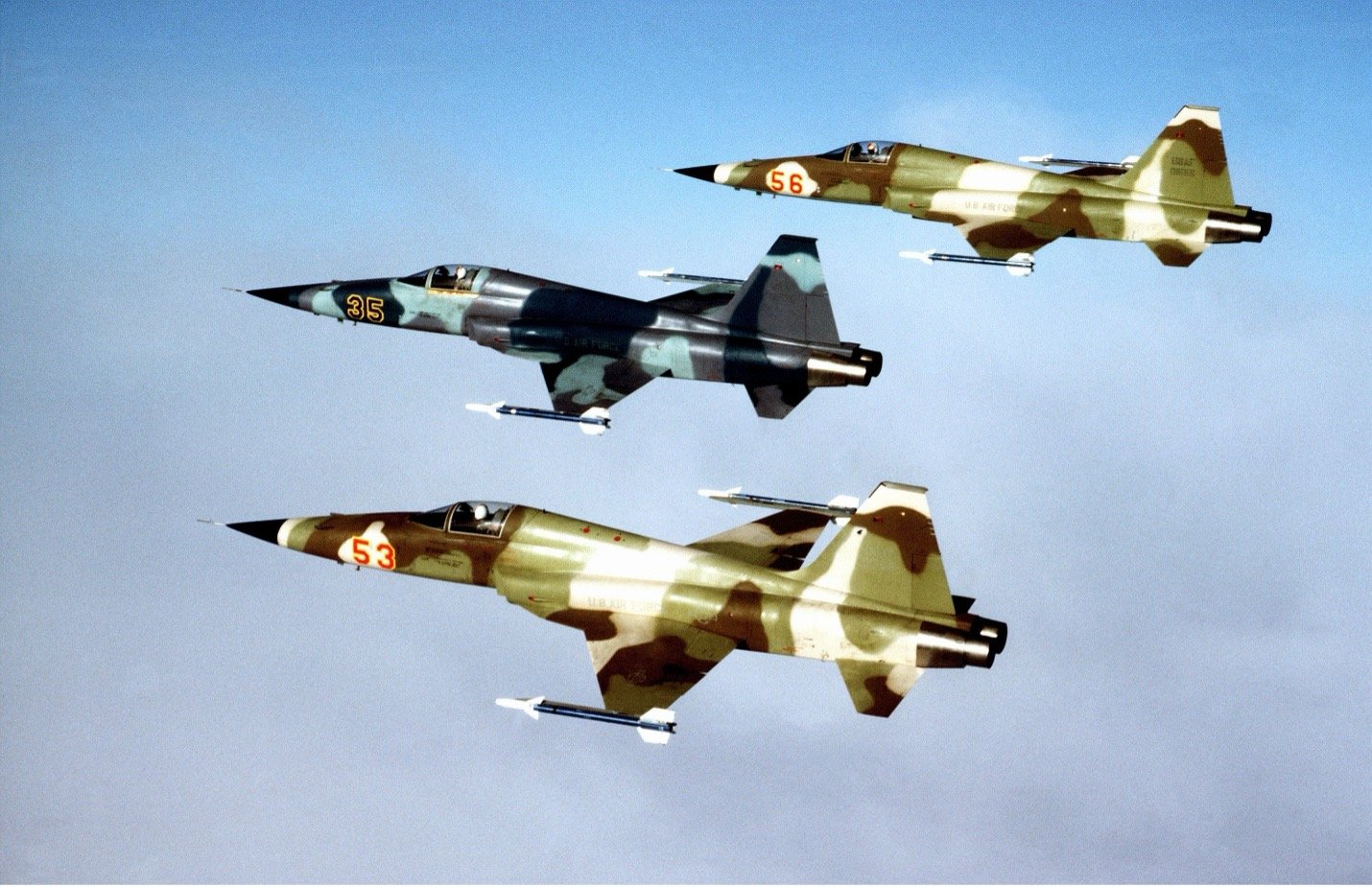
F-5E Aggressors
South Vietnam was using F-5s. After the country fell to the communists, some were given to the Soviet Union. Taking them home and test-flying them, the Russians were amazed at how much better they were than their MiG-21s. So they kept the findings secret, but what they learned helped them develop the awesome MiG-29.
In 1977, Ethiopian pilots in F-5s went up against Somali pilots in MiG 21s, shooting down twelve of them and thirteen more MiG 17s.
There is a list of 38 countries on Wikipedia still using the F-5. Not bad for a sixty-year-old design.
By the way, the two-seat version of the F-5 is known as the T-38 Talon. It has been the supersonic trainer for the U.S. Air Force since forever.
But why in the world would anybody in the government or the military spend $9.6 billion dollars instead of $64.5 billion? Taxpayer money is endless, right? That’s why we are $38 trillion in debt.
I never proposed my idea to the government or anyone else. Needless to say, the F-16 and the newer F-18 Super Hornets are superior aircraft. My idea was a numbers game, with, of course, a personal interest.
Looking back, this whole idea was a joke, or at best, a fantasy. The government would never use civilians as fighter pilots. And if it ever came to that point, it would be too late to build the airplanes and train the pilots.
These days, with so many countries still flying F-5s, I wonder if they need any help?